2. 11. 2009

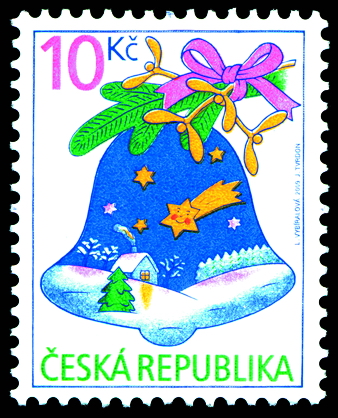
Christmas

CZK 10 (WIFAG)
Date of issue: 4.11.2009
Author: Lenka Vybíralová
Engraver: Jaroslav Tvrdoň

Long before the arrival of Christianity December used to be a month of festivities. Its peaceful and joyful character has still been preserved. It is the month when the real winter season begins here. It was the time when ordinary people could take a breath after the hard summer and autumn work, after harvesting and storing of crops. Late December thus became a time of rest, relaxation and relatively sufficient food. The main thing about Christmas used not to be gifts; it was rather about love and friendship, joy and feeling the unity of the family members who met under the one roof to celebrate Christmas together. On the Christmas Eve people used to feast since the morning to see the "golden pig" in the evening. The dinner began with a common prayer and thanksgiving to God. The dinner being finished, those gathered would try to see their future by, for instance, cutting apples or pouring lead into water as well as by exercising other habits. The Christmas Eve's celebrations culminated with the midnight mass in the local church. The annual Christmas postage stamp features this peaceful high season with the comet on the night sky and village huts covered with snow.


--

--

Vánoce

10 Kč (WIFAG)
Den vydání: 4. 11. 2009
Autor: Lenka Vybíralová
Rytec: Jaroslav Tvrdoň

Prosinec byl dávno před příchodem křesťanství slavnostní dobou a svůj charakter klidných a radostných svátků si podržel dodnes.U nás začínala opravdová zima teprve v prosinci. Byla to doba, kdy si prostí lidé mohli oddechnout po namáhavém létě a podzimu, po sklizních a uskladnění úrody. Proto byl konec prosince dobou odpočinku, uvolnění i poměrného dostatku jídla. Vánoce nebyly ani tak o dárcích, jako spíše o vzájemné lásce a přátelství, radosti a pocitu sounáležitosti v rodině, která se sešla ke společným oslavám pod jednou střechou. O Štědrém dnu se lidé od rána postili, aby večer uviděli “zlaté prasátko”. Večeři zahajovala společná modlitba a poděkování Bohu. Po večeři se věštila budoucnost třeba rozkrojováním jablíček či litím olova do vody a dalšími zvyky. Štědrovečerní oslavy vyvrcholily půlnoční mší v kostele. Tato poklidná sváteční atmosféra s kometou na noční obloze a chaloupkami zavátými sněhem je námětem letošní vánoční známky.


Czech Post - Postfila: http://www.cpost.cz/cz/filatelie/
B. J.
Works of art on postage stamps

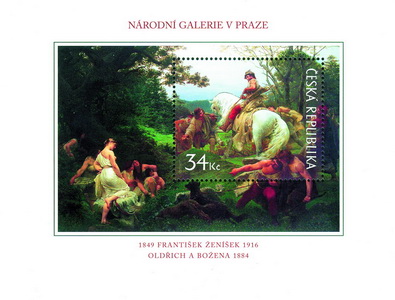
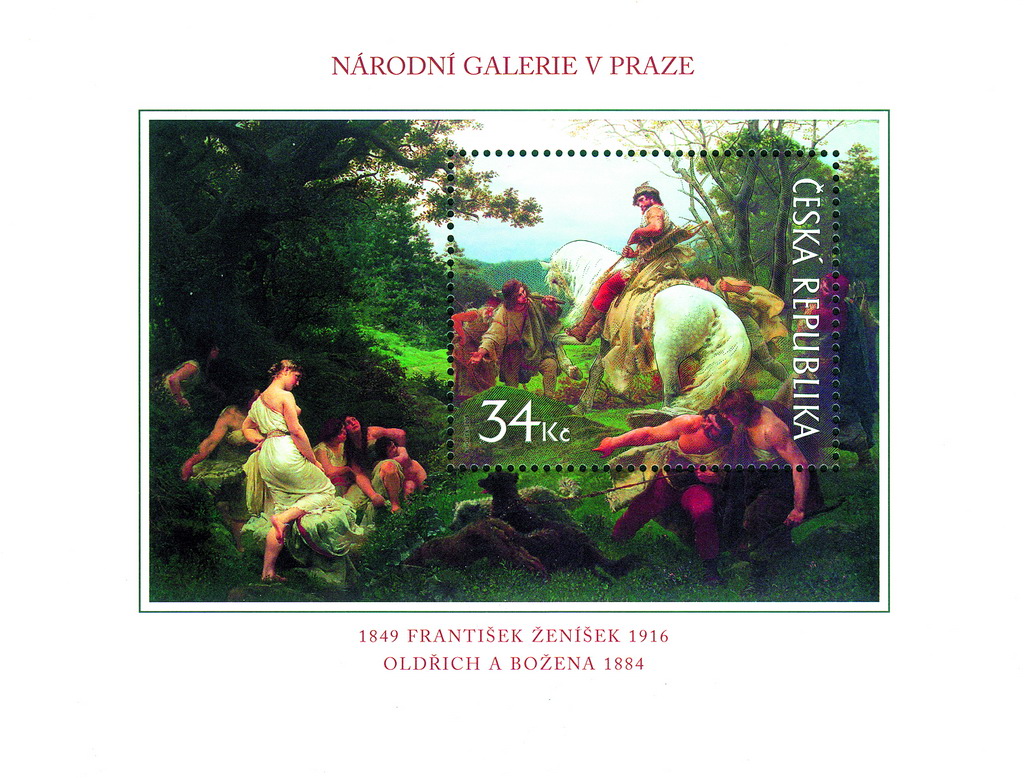
Book of stamps with the CZK 34 postage stamp (Waite + OFFSET)
Date of issue: 4.11.2009
Oldřich and Božena, 1884
František Ženíšek (1849-1916)
National Gallery in Prague
Engraver: Bedřich Housa

F. Ženíšek was a member of the famous generation of the National Theatre renowned mainly for decorations of the National Theatre and the National Museum. He studied at the Academy of Fine Arts in Prague where he also later taught, and in Vienna. His academically smooth form was influenced with neo-Renaissance, with a strong emphasis on patriotism and clear relations to the work by J. Mánes. This extraordinarily talented and hardworking author used drawing as the main tool of expression, leaving to colour the basic role of colouring. He painted the eight allegorical figures in the stage ceiling at the National Theatre where he also decorated walls of the foyer and won the competition for design of the main curtain. The curtain was destroyed at the 1881 fire. Ženíšek is the author of the lunettes in the National Museum, carton designs for the murals in Grégr Hall in the Municipal House and sgrafittos in the Old Town Water Tower. As a sought-after author of portraits he painted about 80 portraits (e.g. Cardinal Schwarzenberg, architect Stibral). Ženíšek paintings are appreciated for their high technical level. The monumental painting Oldřich and Božena, painted for the knight J.S. Doubek, was his most popular painting whose reproductions in colour were broadly spread locally.


--

--

Umělecká díla na známkách

Aršík se známkou 34 Kč (Waite + ofset)
Oldřich a Božena, 1884
František Ženíšek (1849-1916)
Národní galerie v Praze
Rytec: Bedřich Housa

F. Ženíšek byl příslušníkem slavné generace Národního divadla, která se zapsala zejména výzdobou Národního divadla a Národního muzea. Studoval na Akademii v Praze, kde později vyučoval, a ve Vídni. Tvořil v akademicky uhlazené formě ovlivněné neorenesancí se silným důrazem na vlastenectví; zřejmá byla jeho návaznost na dílo J. Mánesa. Byl mimořádně nadaný a pracovitý. Kresbu povýšil na hlavní výrazový prostředek a barva měla vpodstatě kolorující úlohu. V Národním divadle vytvořil osm alegorických postav na stropě hlediště, vyzdobil stěny foyeru a zvítězil v soutěži na návrh hlavní opony. Ta však byla při požáru r. 1881 zničena. Ženíšek je autorem lunet v Národním muzeu, kartónů k nástěnným obrazům v Grégrově sále Obecního domu a sgrafit pro Staroměstskou vodárnu. Byl také vyhledávaným portrétistou, vytvořil na 80 portrétů (např. kardinála Schwarzenberka, arch. Stibrala). Ženíškovy malby jsou ceněny pro svou vysokou technickou úroveň. Monumentální obraz Oldřich a Božena namaloval pro rytíře J. S. Doubka. Byl to jeho nejpopulárnější obraz, který byl u nás hojně šířen v barevných reprodukcích.


Czech Post - Postfila: http://www.cpost.cz/cz/filatelie/
B. J.

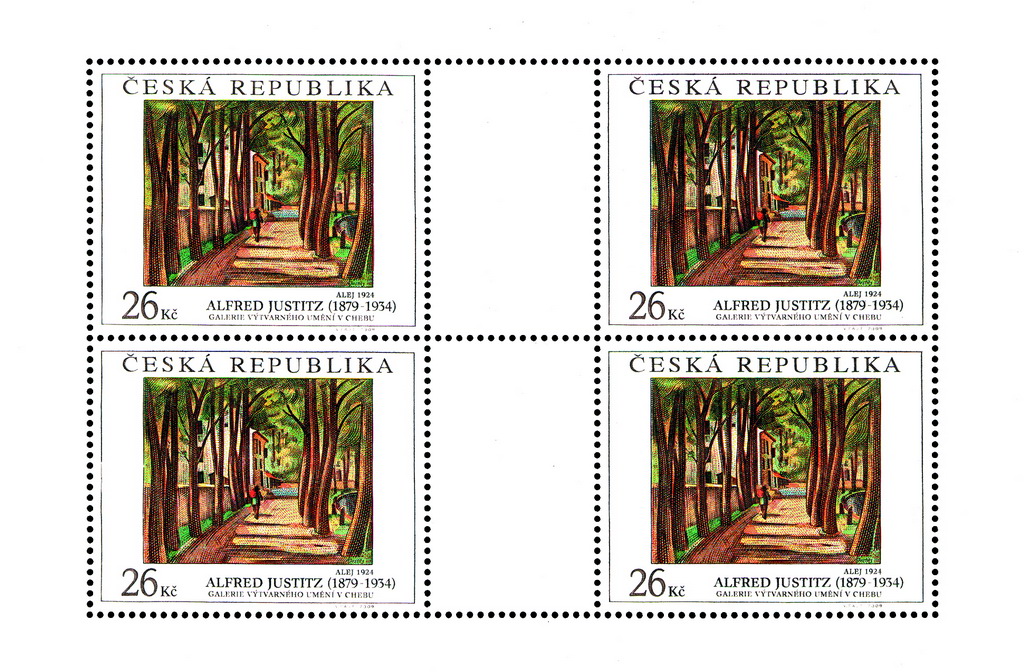
Works of art on postage stamps

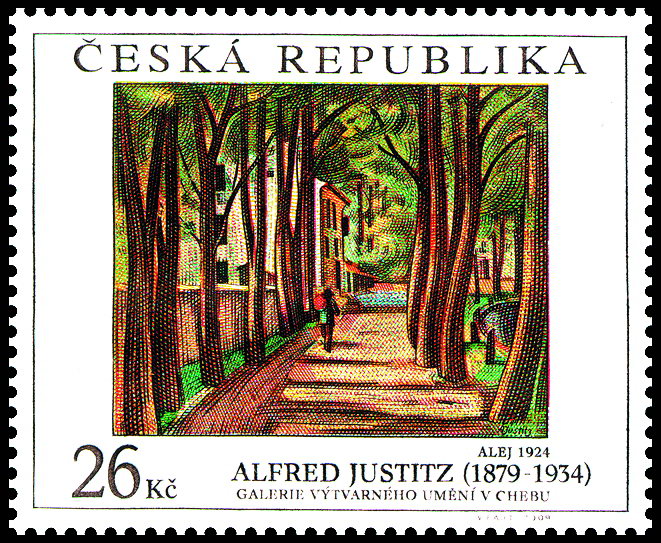
The CZK 26 postage stamp
Date of issue: 4.11.2009
An Alley, 1924
Alfred Justitz (1879-1934)
The Gallery of Fine Arts in Cheb
Engraver: Václav Fajt

The Czech painter, graphic designer and illustrator A. Justitz belongs to the generation of founders of modern Czech painting. He was born to a Jewish family. Formerly a student of architecture at the Czech Institute of Technology, he later continued his studies at the Academy of Fine Arts in Prague under Pirner and Thiele. He studied painting also in Karlsruhe and Berlin. As an artist Justitz always sought his own way. Under the influence of P. Cézanne, he left academic painting and discovered the space creative effects of colour and principles of composition. In the 1920s he underwent further transformation under the strong effect of A. Derain's neo-classicist style. Cubism also left significant marks on his work. The extent of genres in Justitz' work is large. He painted landscapes, still lives, portraits, biblical scenes, not to forget his posters. His most valuable works are figural compositions painted in a distinctive way combining cubist and neo-classicist inspirations. In his last period he tried to create synthetic cubism. The artist's way was broken by his sudden death. The postage stamp features an engraved version of his painting An Alley. Landscape paintings were the main part of Justitz' work in the mid-1920s.


--

--

Umělecká díla na známkách

Známka 26 Kč
Alej, 1924
Alfred Justitz (1879-1934)
Galerie výtvarného umění v Chebu
Rytec: Václav Fajt

Český malíř, grafik a ilustrátor
A. Justitz náleží k zakladatelské generaci českého moderního malířství. Pocházel z židovské rodiny. Zpočátku studoval na české technice architekturu, ale přešel na Akademii výtvarných umění v Praze, kde byli jeho profesory Pirner a Thiele. Malířství studoval rovněž v Karlsruhe a Berlíně. Justitz vždy hledal vlastní uměleckou cestu. Pod vlivem P. Cézanna opustil akademickou malbu a objevil prostorotvornou účinnost barvy a principy kompozice. Ve 20. letech prošel další proměnou. Silně na něj zapůsobil neoklasicistní styl A. Deraina. Též kubismus se významně podílel na jeho tvorbě. Justitzovo dílo je žánrově velmi obsáhlé. Maloval krajiny, zátiší, portréty i biblické motivy, nepřehlédnutelná je plakátová tvorba. Figurální kompozice malované osobitým způsobem spojujícím podněty kubistické a neoklasicistní patří k jeho nejhodnotnějším výtvorům. V posledním tvůrčím období se snažil o syntetický kubismus. Jeho uměleckou dráhu přerušila náhlá smrt. Na známce je rytecký přepis obrazu Alej. Krajinomalba tvoří hlavní náplň Justitzova díla z pol. 20. let minulého století.

Czech Post - Postfila: http://www.cpost.cz/cz/filatelie/
B. J.
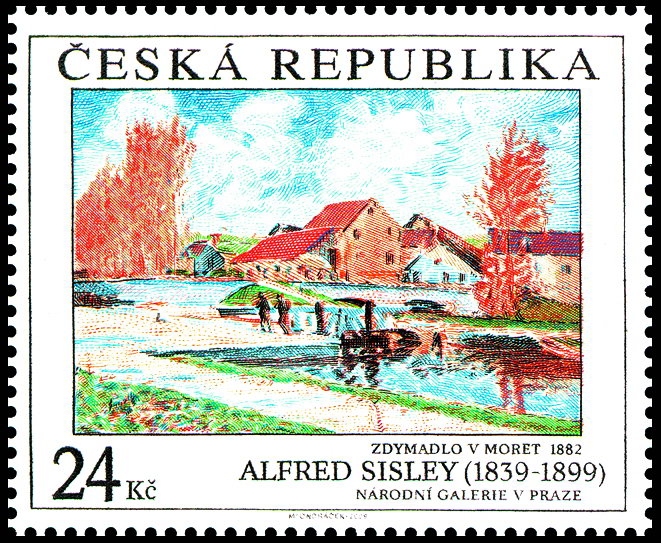
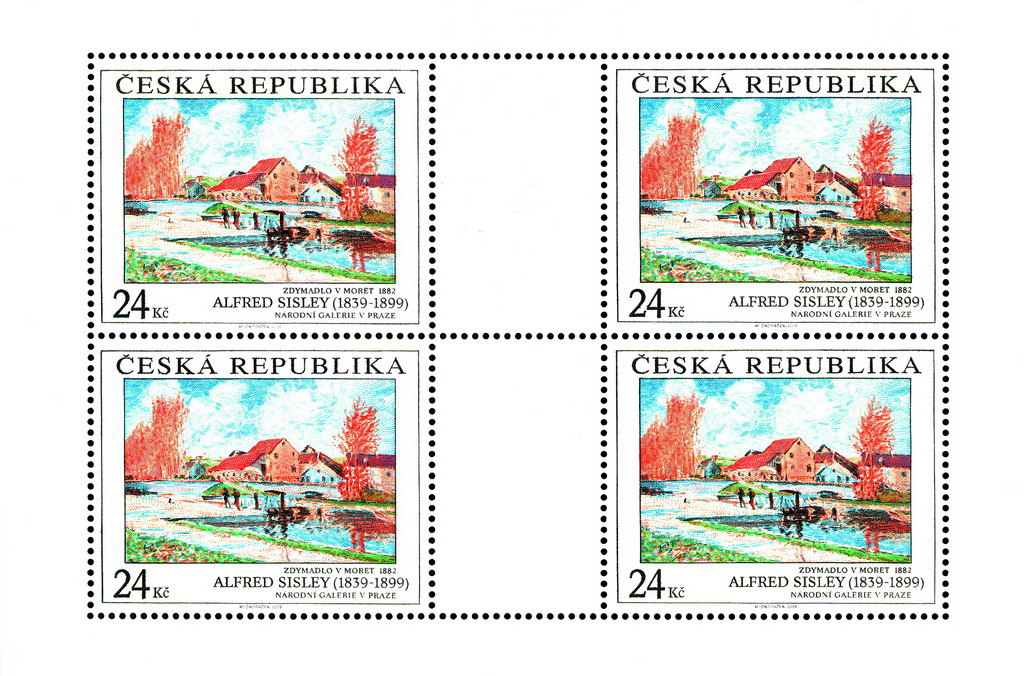
Works of art on postage stamps

CZK 24 book of stamps (waite + OFFSET)
Date of issue: 4.11.2009
The CZK 24 postage stamp
Canal Lock in Moret, 1882
Alfred Sisley (1839-1899)
National Gallery in Prague
Engraver: Miloš Ondráček

Alfred Sisley was a French painter of the English origin. Born in Paris, he studied there fine arts at École des Beaux Arts with the independent teacher Ch. Gleyr. He became a friend of C. Monet, E. Bazill and A. Renoir. Together they worked in the plain-air in Fontainebleau and laid the basis of impressionism. At the beginning Sisley was influenced by G. Courbet and J.B.C. Corot; later he assumed the technique of pure colours and fragmented handwriting without loosing sense of consistent shape. An exclusive landscape painter, he was able to catch its emotional power. His paintings are full of motion with a special dynamism, his fine and detailed approach indicating the depth of the presented nature. His most frequent themes came from the area of the river Seina, from Ile-de-France, the surroundings of Fontainebleau
and from Moret-sur-Loing where he settled in 1879. Sisley is the author of about nine hundred paintings. The postage stamp features a design of his painting the Canal Lock in Moret. The credit deserved by Sisley came only after his death.

--

--

Umělecká díla na známkách

24 Kč, 26 Kč (WAITE), 34 Kč aršík (waite + ofset)
Den vydání: 4. 11. 2009

Známka 24 Kč
Zdymadlo v Moret, 1882
Alfred Sisley (1839-1899)
Národní galerie v Praze
Rytec: Miloš Ondráček

A. Sisley byl francouzský malíř
anglického původu. Narodil se v Paříži, kde studoval výtvarné umění na škole École des Beaux Arts u nezávislého učitele Ch. Gleyra. Zde se spřátelil s C. Monetem, E. Bazillem a A. Renoirem. Společně pracovali v plenéru ve Fontainebleau a položili základ impresionismu. Zpočátku byl Sisley ovlivněn G. Courbetem a J. B. C. Corotem, ale později přejal techniku čistých barev a děleného rukopisu, aniž by ztratil smysl pro soudržný tvar. Maloval výlučně krajinu, kterou dokázal emočně zachytit v její síle. Jeho obrazy jsou plné pohybu se zvláštní dynamikou, jemný a detailní přístup naznačuje hloubku zobrazené přírody. Nejčastěji maloval motivy z povodí Seiny, z Ile-de-France, z okolí Fontainebleau a Moret-sur-Loing, ve kterém se v r. 1879 usadil. Sisley vytvořil na devět set pláten. Jeho obraz Zdymadlo v Moret je rytecky převeden na známce. Zaslouženého uznání se Sisleymu dostalo až po smrti.

Czech Post - Postfila: http://www.cpost.cz/cz/filatelie/
B. J.
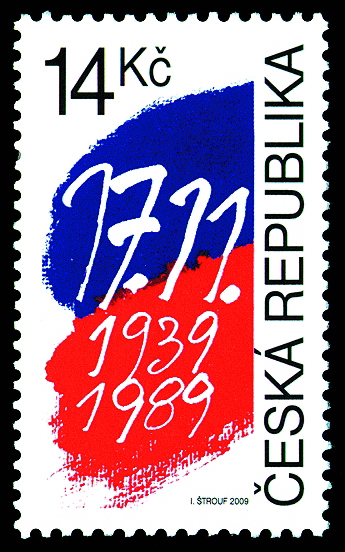
17 november - the years 1939 and 1989

CZK 14 (OFFSET)
Date of issue: 4.11.2009
Author: Ivan Štrouf
Engraver of the FDC: Jaroslav Tvrdoň

On October 28, 1939, the anniversary date of establishment of the Czechoslovak Republic, people gathered at numerous demonstrations in towns of the Protectorate of Bohemia and Moravia, the stormiest of which were held in Prague. Large numbers of people were arrested, two men - the medical student J. Opletal and the worker V. Sedláček - who were shot suffered from fatal injury. The funeral of the student J. Opletal on 15 November in Prague ended in another spontaneous anti-Nazi demonstration. As a result, the Reichsprotektor ordered raids on students at Prague and Brno campuses in the night of 17 November. 9 student officers were executed without trial in Prague at the Ruzyně barracks, another 1,070 students were deported into concentration camps. On Hitler's order Czech universities were closed for 3 years.


17 November became the symbol of young generation fighting against the totalitarian power. The International Students' Council, set up in London soon afterwards, declared 17 November as the International Students Day.

On November 17, 1989, students met again in Prague at Albertov to commemorate the 50th anniversary of these events. As allowed by the authorities, they took the road to Vyšehrad, to the tomb of the famous Czech poet K.H. Mácha. The large assembly of students then continued their way downtown to the National Theatre and the Národní street where they met a police cordon with shields, helmets and truncheons. The enclosed students were brutally beaten. The event aroused a huge public anger with the resulting protest events. University students, soon joined by actors of all theatres, declared occupation strikes. Hundreds of thousands of people gathered in the centre of Prague to manifest against the regime. They called for removal of the Communist Party monopoly and democratisation of political life.

November 17, 1989 marked the beginning of stormy political events resulting into the fall of the communist regime in Czechoslovakia.

--

--

17. listopad – rok 1939 a 1989

14 Kč (oFset)
Den vydání: 4. 11. 2009
Autor: Ivan Štrouf
Rytec FDC: Jaroslav Tvrdoň

Ve výroční den vzniku Československé republiky 28.10.1939 proběhly v řadě měst v protektorátě Čechy a Morava demonstrace, které byly nejbouřlivější v Praze. Mnoho lidí bylo zatčeno a střelbou byl smrtelně zraněn medik J. Opletal a dělník V. Sedláček. Smuteční rozloučení se studentem J. Opletalem 15.11. v Praze vyznělo jako spontánní demonstrace proti okupantům. V noci na 17. listopad 1939 nařídili nacisti razie ve studentských kolejích v Praze a Brně. Došlo k zatýkání a 9 studentů funkcionářů bylo v Praze v ruzyňských kasárnách bez soudu popraveno, dalších 1 070 studentů deportováno do koncentračních táborů. Z Hitlerova příkazu byly na 3 roky uzavřeny české vysoké školy.


17. listopad se stal symbolem boje mladé generace proti totalitní moci. Brzy nato byla v Londýně ustanovena Mezinárodní studentská rada, která vyhlásila 17. listopad za Mezinárodní den studentstva.

K 50. výročí těchto událostí se opět 17. listopadu 1989 sešli studenti v Praze na Albertově, odkud jejich průvod směřoval na Vyšehrad, ke hrobu K. H. Máchy. Tato trasa byla úřady povolena. Mohutné shromáždění se dále vydalo po nábřeží k Národnímu divadlu a dále na Národní třídu, kde se ocitlo v obklíčení ozbrojených policistů vybavených štíty, helmami a obušky a vyvrcholilo brutálním zásahem proti studentům. Zásah vyvolal obrovské rozhořčení veřejnosti a protestní akce. Byla vyhlášena okupační stávka na vysokých školách a do stávky vstoupili herci všech divadel. V centru Prahy se konaly statisícové manifestace. Občané žádali odtranění monopolu KSČ a demokratizaci politického života.

17. listopad 1989 znamenal začátek bouřlivých politických událostí, které vyústily v pád komunistické moci v Československu.

Czech Post - Postfila: http://www.cpost.cz/cz/filatelie/
B. J.
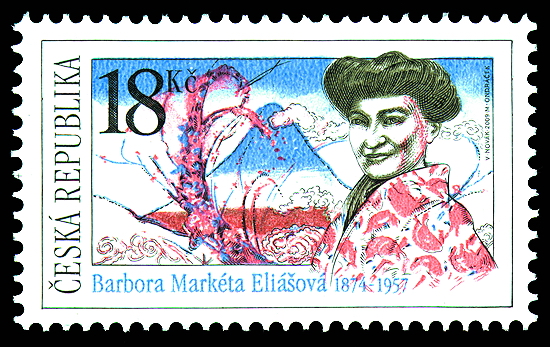
The traveller Barbora Markéta Eliášová

CZK 18 (WIFAG)
Date of issue: 14.10.2009
Author: Vladimír Novák
Engraver: Miloš Ondráček

B.M. Eliášová (1874-1957) was the first Czech female traveller who went around the world. An orphan since her four years of age, she was brought up at the community cost in her native Jiříkovice village near Brno. The local teacher Jan Hudeček who paid a great attention to the talented Eliášová had an essential effect on her life. From the age of fourteen she worked as a charwoman. As a graduate from a private language school in Prague she taught mainly English and German at girls' schools. In July 1912 she took a year's holiday, went to Vladivostok by train from where she voyaged to Japan. She first lived in the family of the English university teacher Lawrence, later in a hotel at the outskirts of Tokyo occupied solely by the Japanese. She again worked as a language teacher. Soon she learned Japanese and made many friends among her students and colleagues. This gave her the opportunity to learn in detail about everyday life and the famous history of Japan. Eliášová was the first European student of an ikebana course - the traditional Japanese art of flower arrangement. In 1915, after her return back to Bohemia via the United States, she published the book A Year of Life Among the Japanese and Around the Globe" to meet the great interest in her experiences. In 1920 she returned to Japan as an officer of the Czechoslovak Embassy in Tokyo. A fellow of the Woman University and the Waseda University, she made a series of lectures on Czechoslovakia and wrote articles for Czech and Japanese periodicals. Eliášová stayed in Japan for several times more; in 1923 she lived through the deadly Yokohama earthquake. Back at home she gave radio and public lectures on her stories and experiences from her travels through Hong-Kong, Singapore, Ceylon, China, Korea, the Soviet Union, Java, Australia, Africa. The author of several books, she spent her last years in Roztoky u Prahy and Prague.


The postage stamp pays tribute to this remarkable and brave woman.


--

--

Cestovatelka Barbora Markéta Eliášová

18 Kč (WIFAG)
Den vydání: 14. 10. 2009
Autor: Vladimír Novák
Rytec: Miloš Ondráček

B. M. Eliášová (1874-1957) byla první českou cestovatelkou, která objela svět. Ve čtyřech letech osiřela a byla v rodných Jiříkovicích nedaleko Brna vychovávána na obecní náklady. Zásadní vliv na její osud měl zdejší učitel Jan Hudeček, který se nadané Eliášové velmi věnoval. Od čtrnácti let se živila jako posluhovačka. Po studiu na soukromé jazykové škole v Praze vyučovala na dívčích školách především angličtinu a němčinu. V červenci 1912 si vzala roční dovolenou, vlakem odcestovala do Vladivostoku a odtud lodí do Japonska. Žila v rodině anglického univerzitního profesora Lawrence a později v hotelu obývaném výhradně Japonci na okraji Tokia. Opět si vydělávala výukou jazyků. Velmi brzy se naučila japonsky a mezi žáky a kolegy získala mnoho přátel. To jí umožnilo zblízka poznat každodenní život i slavnou historii Japonska. Eliášová byla první evropskou absolventkou kurzu ikebany – tradičního japonského umění vazby květin. Po návratu do Čech přes USA vydala v r.1915 pro velký zájem své zážitky v knize Rok života mezi Japonci a kolem zeměkoule. R. 1920 se do Japonska vrátila jako pracovnice československého velvyslanectví v Tokiu. Spolupracovala s ženskou univerzitou a univerzitou Waseda, uspořádala několik přednášek o Československu a přispívala do českých i japonských periodik. Do Japonska se Eliášová vrátila ještě několikrát – v r. 1923 zažila v Jokohamě ničivé zemětřesení. Procestovala Hongkong, Singapur, Cejlon, Čínu, Koreu, SSSR, Jávu, Austrálii, Afriku. Doma pak o svých zážitcích a poznatcích vyprávěla na besedách a přednášela v rozhlase. Napsala i několik knih. Poslední léta prožila v Roztokách u Prahy a v Praze.


Známka vychází jako hold této obdivuhodné a nezlomné ženě.

Czech Post - Postfila:
http://www.cpost.cz/cz/filatelie/
B. J.
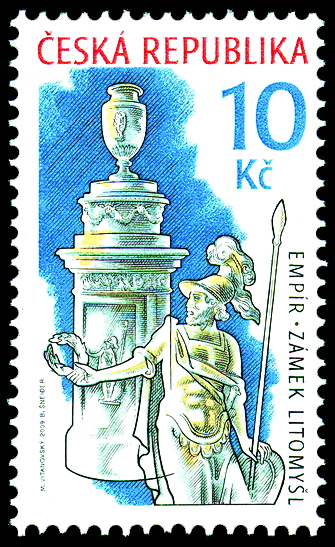
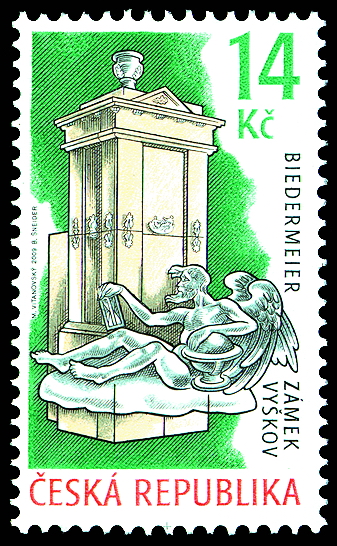
Crafts: historical stoves

CZK 10, CZK 14 (WIFAG)
Date of issue: 14.10.2009
Author: Michal Vitanovský
Engraver: Bohumil Šneider

This issue relates to the postage stamps of the previous two years featuring historical glazed-tile stoves.


The CZK 10 postage stamp – Empire stove, around 1810 – The chateau in Litomyšl
Empire stoves of the early 19th century were based on the morphology of Classicism. Their authors drew a deeper inspiration from ancient Greece and Rome and gradually simplified the outline as well as individual segments of stove body. The basic geometric shapes were cylinder, prism and pyramid. Unlike the white glazing prevalent in the previous era, the tiles of Empire stoves were more colourful. The broken shades of the background, added to the white and ivory-white of the previous era, made the raised decorations more distinguishable. A raised decoration used frequently were anticising vases. Raised figures from ancient Greece and Rome appeared together with ancient and old-Egyptian ornaments.

The CZK 14 postage stamp – Biedermeier stove, around 1835 – The chateau in Vyškov
Unlike the pompous and representative Empire, Biedermeier, also known as petit-bourgeois Empire, was more factual and practical. Biedermeier stoves are based on austere rectangular structure of support and head pieces whose apertures facilitated the best possible heating. The modest raised decorations on large smooth surfaces are present mostly in the least possible number. New themes taken from nature and everyday life appear in addition to the ancient themes of the Empire style.


--

--

Umělecká řemesla: historická kamna

10 Kč, 14 Kč (WIFAG)
Den vydání: 14. 10. 2009
Autor: Michal Vitanovský
Rytec: Bohumil Šneider

Tato emise navazuje na známky z předchozích dvou let s historickými kachlovými kamny.


Známka 10 Kč – Empírová kamna, kol. r. 1810 – zámek Litomyšl


Empírová kamna vycházela poč. 19. stol. z tvarosloví klasicismu. Jejich tvůrci se důsledněji inspirovali antikou a postupně zjednodušovali siluetu i jednotlivé články kamnového tělesa. Základem byly geometrické tvary válce, hranolu i jehlanu. Proti převážně bílým glazurám předchozího období byla empírová kamna barevnější. K přetrvávající bílé a slonovinové barvě přibyly lomené tóny pozadí, které daly vyniknout reliéfním ozdobám. Častým plastickým zakončením byly antikizující vázy. Figurální reliéfy se starověkými náměty byly doplňovány antickými a staroegyptskými ornamenty.

Známka 14 Kč – Kamna biedermeier, kol. r. 1835 – zámek Vyškov

Proti okázalému a reprezentativnímu empíru byl biedermeier věcnější a praktičtější a bývá nazýván měšťanským empírem. Kamna biedermeieru tvoří strohá pravoúhlá skladba podpěr a překladů, jejíž otvory umožňovaly co nejlepší vyhřívání. Reliéfní výzdoba je skromná a většinou jen minimálně doplňuje velké hladké plochy. Kromě antických témat převzatých z empíru se nově vyskytují motivy z přírody a každodenního života.


Czech Post - Postfila: http://www.cpost.cz/cz/filatelie/
B. J.
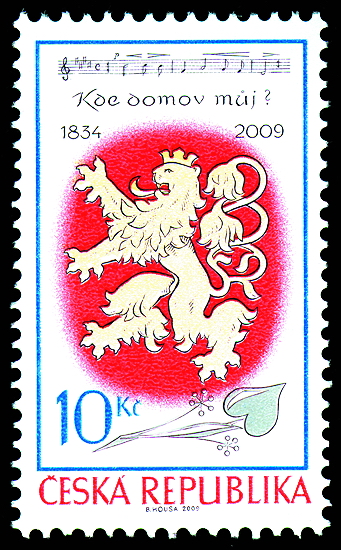
The song "where is my home" - the czech national anthem

CZK 10 (WIFAG)
Date of issue: 14.10.2009
Author and engraver: Bedřich Housa

The play Fidlovačka aneb žádný hněv a žádná rvačka (Fidlovačka, Or No Anger and No Brawl) written by Josef Kajetán Tyl (1808-1856) is a musical comedy featuring a party of Prague shoe-makers. The author of the music in the play, run for the first time on December 21, 1834 at the Estates Theatre in Prague, was František Škroup (1801-1862). One of the songs - Where in My Home? - became so popular that its first strophe later became a part of the Czechoslovak anthem and, since 1993, the Czech national anthem.

In 1831-42 the writer and playwright J.K. Tyl worked as a clerk in the 28th infantry regiment's office in Prague. He lived in the Truhlářská street adjacent to the barracks of the regiment. Here he wrote the song Where is my home?, edited the magazine Květy and prepared repertory for the Kajetán Theatre established by him.

At the time when he composed the music for the song the musician F. Škroup lived in the Myslíkova street, house number 187, where he nursed his sick first wife. An excellent conductor at the Estates Theatre, he conducted numerous classic operas, composed a number of overtures and scenic music for several plays. He also deserved merit as composer of Czech songs and choruses. In 1860 he got the job of conductor at the German Opera in Rotterdam where he was also buried.

The first interpreter of Where is my home?, the song of the blind beggar Mareš, was the famous basso singer Karel Strakatý (1804-1868). Although he was offered jobs by leading European opera houses (Berlin, Dresden, Vienna) already in the first years of his theatre performances, K. Strakatý remained loyal to his beloved Prague. He exercised his sonorous voice of a great range for over thirty years at 3,230 performances.

--

--

Píseň „Kde domov můj?“ – česká státní hymna

10 Kč (WIFAG)
Den vydání: 14. 10. 2009
Autor a rytec: Bedřich Housa

Hra Fidlovačka aneb žádný hněv a žádná rvačka, kterou napsal Josef Kajetán Tyl (1808-1856), je fraška ze slavnosti pražských ševců. Hra, která měla premiéru 21.12.1834 ve Stavovském divadle v Praze, je proložena zpěvy na hudbu Františka Škroupa (1801-1862). Jedna z písní – Kde domov můj? – získala takovou popularitu, že znárodněla a později se její první sloka stala součástí československé hymny a od r. 1993 je českou státní hymnou.
V letech 1831-42 byl spisovatel a dramatik J. K. Tyl účetním ve vojenské kanceláři v kasárnách 28. pěšího pluku v Praze a ve vedlejší Truhlářské ulici bydlel. Zde napsal píseň Kde domov můj?, redigoval časopis Květy a připravoval repertoár pro Kajetánské divadlo, které založil.

Hudebník F. Škroup bydlel v Myslíkově ul. 187 a ošetřoval svou nemocnou první ženu v době, kdy skládal k písni hudbu. Škroup byl výborným dirigentem a za svého působení ve Stavovském divadle nacvičil mnoho klasických oper, složil řadu předeher a scénickou hudbu k některým hrám. Získal také zásluhy jako skladatel českých písní a sborů. V r. 1860 přijal místo kapelníka u německé opery v Rotterdamu, kde je i pochován.

Prvním interpretem písně Kde domov můj? slepého houslisty žebráka Mareše byl slavný pěvec-basista Karel Strakatý (1804 - 1868). Již v prvních letech své divadelní činnosti obdržel K. Strakatý nabídky z předních evropských operních scén (berlínské, drážďanské i vídeňské), ale zůstal věren své milované Praze. Svým zvučným hlasem velkého rozsahu zpíval K. Strakatý přes třicet let ve 3230 představeních.

Czech Post - Postfila:
http://www.cpost.cz/cz/filatelie/
B. J.
1. 11. 2009

Jewish Nation Persecution in the Protectorate of Bohemia and Moravia and Terezín Ghetto in Mail Documents

Michal Hauzr

Dear philatelists and visitors of Japhila.cz and Exponet.info web pages. An innovated exhibit named "Jewish Nation Persecution in the Protectorate of Bohemia and Moravia and Terezín Ghetto in Mail Documents" has been introduced today on the world virtual philatelic exhibition web.

As its name suggests, it introduces in the first place mail documents from the period of occupation of Czech lands by German army during the World War II related directly or indirectly to unprecedented violation of elementary principles of humanity among members of two different ethnics with massive support of various poltroons, freeloaders, gold miners, opportunists and revengeful people, and even with unintentional collaboration of ordinary citizens...


All article with pictures: http://www.japhila.cz/pdf/Jewish_nation_persecution.pdf

On line exhibit on Exponet: http://www.japhila.cz/hof/0335/index0335a.htm

30. 10. 2009

Filatelistická pošta ve dvoraně Hlavní pošty

Dobrý den,
oznamuji, že prodejny filatelie - přepážky č. 29 a č. 30 pošty Praha 016 (v hale Hlavní pošty Praha 1) budou od pondělí 2. 11. 2009 opět otevřeny pro veřejnost v době pondělí až pátek od 08,00 hod. do 18,00 hod.


Také vám chci připomenout, že 4. 11. 2009 budeme mít v prodeji (mimo tradičních "novinek") dopisnici (PostFila) k výročí 17. listopadu 1989 (zn.10,- Kč). Pošta Praha 016 pro vás připravila k této významné události přítisk na zn. s kupónem (Brána s pávem 10,- Kč). Máme obě varianty - přítisk PostFila i přítisk VSP. Příležitostné razítko k 17. 11. bude používat pošta Praha 1 od 16. do 31. 11.2009 na přepážce č. 17. Máte tedy dost času, zakoupit a připravit si potřebný materiál.

Přeji pěkný víkend.
Marie Chábová
vedoucí pošty Praha 016

27. 10. 2009

Internationale Briefmarken-Börse Sindelfingen

Insgesamt positive Bilanz der Nummer 27 Die (am Sonntag zu Ende gegangene) Internationale Briefmarken-Börse Sindelfingen 2009 hat ihre führende Stellung als Top-Ereignis der Briefmarkensammler aller Stufen auch in diesem Jahr halten können. Das eingespielte Veranstaltungskonzept mit einer Mischung als populären und hochwertigen Elementen sei wieder aufgegangen, erklärte Projektleiter Bernward Schubert.Im Mittelpunkt standen ein Briefmarken-Salon „Deutsche Kolonien“ und die internationale Postgeschichte-Ausstellung mit Symposium. Wer gedacht hätte, für deutsche Kolonien interessierten sich nur ausgewiesene Spezialisten, wurde in Sindelfingen eines besseren belehrt. Thomas Knell, Vorsitzender der Arbeitsgemeinschaft der Sammler deutscher Kolonialpostwertzeichen: „Es haben wohl noch nie so viele Leute für dieses reizvolle Sammelgebiet Interesse gezeigt.“ Die Goldenen Posthörner der Postgeschichte-Ausstellung erhalten: Alfred Bohnenblust (Schweiz) für „Die Entwicklung des Briefverkehrs Schweiz-Frankreich 1845 bis 1875“, Dr. Helmut Seebald (Österreich) für „Österreichische Postgeschichte 1945-1975, Die Entwicklung der Post vom Ende der Ostmark bis zum Staatsvertrag 1955“, Axel Schramek (Deutschland) für „Die vorphilatelistischen Stempel des Königreichs Lombardei-Venetien vom Wiener Kongress 1815-1850“, Andre Peine (Frankreich) für „La Poste à Straßbourg du siège des 1870 au 31 decembre 1874“, Christoph Keller (Deutschland) für „Vom Zentralen Kurierdienst zur EMS Kurierpost GmbH“ und Karlfried Kraus (Deutschland) für „Die preußischen Nummernstempel“.„Spielentscheidend“ waren wieder mal die ausgesprochen gut frequentierten Beratungsstände der Arbeitsgemeinschaften und Verbände. Die Warteliste für kommendes Jahr sei schon jetzt auffällig lang, verlautet aus der Messe. Nicht weniger als 5.000 Euro konnten Harald Rauhut, Präsident des Bundesverbandes Deutscher Briefmarkenversteigerer BDB und sein Vize Günter Schreyer am Sonntagmittag an die Aktion „Herzenssache“ überreichen. Sechs BDB-Mitgliedsunternehmen (Schwanke Hamburg, Lindner Stuttgart, Rauss und Fuchs Stuttgart, Fortagne & Lipfert Leipzig, Christoph Gärtner Bietigheim-Bissingen und Ulrich Felzmann Düsseldorf) hatten jeweils live 20 Auktionslose versteigert und den Ertrag für den guten Zweck zur Verfügung gestellt. Christina Benz von dem Kinderhilfswerk nutzte die Gelegenheit, konkrete Hilfsprojekte vorzustellen und nahm gerührt den Scheck entgegen.Der Jugendbereich stand in diesem Jahr ganz im Zeichen des Weltalls. Abdulahad Momand, Kosmonaut von 1988, schrieb für Jugendliche und Erwachsene immer wieder Autogramme, geschätzt rund 2000 Mal. Der Fachhandel aus dem In- und Ausland zeigte sich trotz widriger wirtschaftlicher Rahmenbedingungen und einer leider gleichzeitig in Rom ausgerichteten Briefmarken-Weltausstellung mit den erzielten Umsätzen überwiegend zufrieden. Der Termin der kommenden Internationalen Briefmarken-Börse Sindelfingen steht bereits fest: Es ist wieder das letzte Oktober-Wochenende, also der 29. bis 31. Oktober 2010. Geplant sind zwei Sonderschauen und eine Rang-Ausstellung. Letztgenannte Präsentation steht jedoch unter dem Vorbehalt, dass die Verantwortlichen beim BDPh schnellstmöglich die nötige Planungssicherheit schaffen.Informationen unter www.briefmarken-messe.de

Hinweis an die Redaktionen: Abbildungen und ausführliche Texte stellen wir Ihnen auf Wunsch gerne zur Verfügung.

25. 10. 2009

III. Den české filatelie v Poštovním muzeu v Praze

Ve čtvrtek 5. listopadu proběhne už třetí ročník akce Den české filatelie v Poštovním muzeu v Praze. Pořadateli jsou Česká pošta, s. p., Poštovní muzeum, Svaz českých filatelistů a Klub Filatelie. Jde o klubovou akci jen pro členy SČF, KF a hosty pozvané PM (vstup je na pozvánky, které členové SČF a KF s předstihem obdrželi; muzeum je v tento den pro ostatní veřejnost uzavřeno).

Program:
09.00 – 10.00 Přivítání účastníků III. Dne české filatelie. Možnost nákupu filatelistického materiálu v prodejně muzea.

10.00 – 11.00 Komentovaná prohlídka vybrané části známkové expozice PM (návštěvníky provede znalec F. Beneš).

11.00 – 12.00 Komentovaná prohlídka výstavy Jana Kavana: Poštovní známky a drobná grafika (návštěvníky provede sám autor!).

14.00 – 14,30 Slavnostní křest nové poštovní známky Vánoce, vydané 4. 11. 2009.

14,30 – 16.00 Autogramiáda tvůrců poštovní známky Vánoce (podepisovat se budou výtvarnice L. Vybíralová a rytec J. Tvrdoň).

16.00 – 17.00 Volná prohlídka expozic muzea.

Po celý den bude v Poštovním muzeu otevřena prodejna filatelistického zboží.


Pořadatelé akce

Ing. Vaníček a Mgr. Maleček v Domě Portus

Dovolujeme si vás informovat, že naše další klubové odpoledne se bude konat ve čtvrtek 5. 11. 2009 od 16.00 hod. v sále Dřevák v 1. patře Domu Portus (občanské sdružení Život 90), v Praze 1, ulice Karolíny Světlé 18 (roh s ulicí Betlémskou). Součástí naší akce bude členská schůze klubu s přednáškou Ing. Víta Vaníčka, místopředsedy Svazu českých filatelistů pro zahraniční činnost, a Mgr. Jaroslava Malečka, tajemníka Svazu českých filatelistů, na téma "Zahraniční aktivity Svazu českých filatelistů včetně ukázek filatelistické dokumentace".

Členská schůze s přednáškou bude zahájena v 16.30 hod. Vítáme všechny přátele filatelie. Vstup volný. Pro účastníky bude připravena káva, čaj a minerálka.

Současně s touto zprávou Vám v příloze zasíláme program celého 30. přednáškového cyklu 2009 - 2010. Těšíme se na vaši účast!

Za výbor Klubu filatelistů 00-15, sběratelů specializovaných oborů, v Praze, vás zdraví Ing. Pravoslav Kukačka, jednatel, a Ing. Ladislav Čechák, organizátor odborné činnosti

Příloha: http://www.japhila.cz/pdf/30_cyklus_2009-2010.pdf